


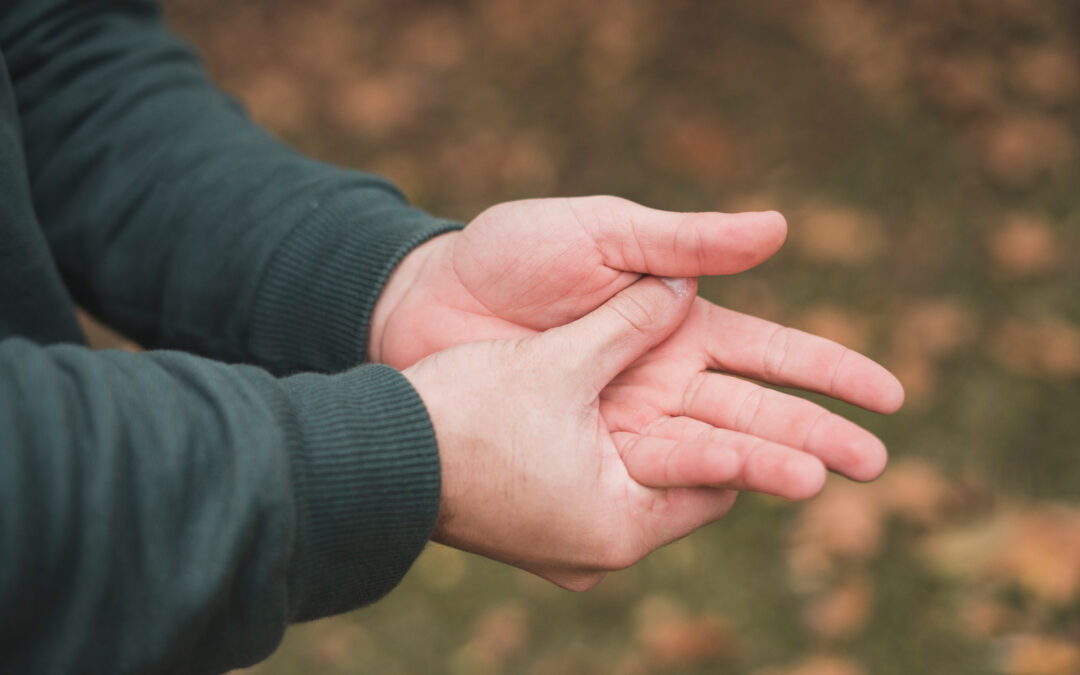
Learn to protect and relax your hands and wrists.
Repetitive stress injuries in the hands are very common. What are your hands like? Sensitive, intelligent, flexible, hard-working… Our hands and wrists are involved in practically everything we do.
They let us do the simplest things, like petting an animal, and far more complex ones, like playing a piece of music.
Throughout the day, hands close, grip, open, push, pull, lift, hold, and turn — according to our needs.
Interestingly, our hands take up a large area of the brain’s motor cortex, and are innervated by more sensory fibres than any other part of the body. And because they’re connected to the autonomic nervous system, our hands can reflect our emotional state very clearly.
Our hands and wrists can feel tension, pain and stiffness as a result of overuse, or of a release routine that’s insufficient or inadequate. Chronic tension in the hands can easily turn into an unconscious habit.
If you work with your hands — writing, playing an instrument — or if you’ve felt pain, fatigue or stiffness in your hands and wrists, or if you repeat a movement often enough that your body signals it’s uncomfortable, these classes are for you.
These are repetitive stress injuries: not one dramatic event, but the slow accumulation of a pattern the body hasn’t yet learned to vary.
The good news is that patterns can change. Not through more force or more stretching, but by learning new ways of moving that engage your nervous system.
What you’ll learn
• Experience differences in your movements, and get curious about your patterns instead of fighting them.
• Notice small shifts in action — the kind that add up over time.
• Learn to use a quality of touch that engages the brain’s own capacity to learn and change.
• Discover the connection of your hands and wrists not just to your shoulders, but to your spine and shoulder blades.
• Observe judgement, and exchange it for understanding.
• Pause. Listen to your body. Discover easier variations. Then let new possibilities emerge.
Where this comes from
Twenty years ago, I experienced firsthand what Scaravelli-inspired yoga, Dr. Feldenkrais’ principles, and Body-Mind Centering, together with Shiatsu (acupressure on the meridians of TCM), could do for my own ability to move without pain. That experience is what pulled me in — with enough curiosity to want to know more, and to keep learning ever since.
In-person and online support
I’ve been teaching in person for more than 16 years, and on Zoom since 2020 — originally for students who only visit the area once or twice a year. With travel more unpredictable and a student community that’s increasingly global, online sessions have gone from an occasional option to something close to essential.
Online classes are especially useful for continuity in the body work.
There’s a lot I can support you with online too, so your progress keeps moving forward.

Practices to work with
• Learn to protect and relax the hands.
• Recover dexterity in the hands.
• Connect, soften and free the rib cage.
• Eyes-hands connection.
• Discover your flexible mind.
• Trust your capacity for proprioception, discernment and decision-making.
• Bring in the element of touch — self-shiatsu, as a way of supporting connection, relaxation and recovery from injury. Work on the meridians of TCM.
Benefits:
• Reduce inflammation and swelling.
• Reduce pain.
• Improve dexterity and comfort.
• Improve range of motion.
• Reduce vulnerability to injury.
• Improve blood and lymphatic circulation in the hands.
• Discover new ways to reduce stress and anxiety.

Work with me

Whether you’re local or joining from wherever you are in the world, in-person and online sessions are both available. If a repetitive strain is asking for your attention, it’s a good time to start listening.