


Your Hands Help Your Brain
What the Hands Reveal — and What They Can Change
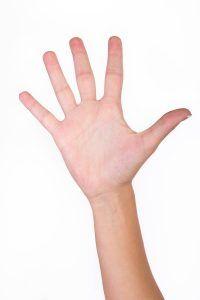
The hands are where inner state becomes visible and touchable — a translation point between what’s happening inside and what can be observed or worked with from the outside.
As a Shiatsu and Body-Mind Centering practitioner, I notice this directly: we treat the hand as a readable surface, often sensing nervous-system state before a word is spoken.
Emotional and nervous-system state shows up in the hands almost immediately. Anxiety tends to show as gripping, fidgeting, cold or tense palms. Fatigue often shows as hands that feel heavy, slow, or oddly disconnected from the rest of the body. Calm, regulated states show up as warmth, looseness, small natural movement.

The Hands Can Change Internal State
The relationship also runs the other way. Deliberately softening the hands, or bringing slow, attentive touch to them, can shift the whole nervous system toward rest. This isn’t symbolic — the hands carry an unusually dense supply of sensory receptors with a fast, direct line to the brain regions involved in interoception and emotional regulation. A hand exercise is never just for the hand. It’s a lever into the whole system.
The hand works almost like a two-way mirror: it reflects the inner state honestly, and it’s also one of the most efficient doors back in.
When we think about mindfulness, we usually picture the breath, or stillness of mind. But there’s a more direct, less abstract path: the hands. Few parts of the body take up as much space in the brain — the motor and sensory cortex devote a disproportionate amount of territory to the hands, precisely because they’re capable of such fine movement and carry so much sensory detail. This is the basis of the classic “homunculus” — the distorted little body-map with giant hands, giant lips, and a tiny torso.
Why Practice Often Starts at the Hands
This is why so much touch-based and movement-based work begins at the periphery rather than the center. Shiatsu working through the meridian points of the hand, or a Feldenkrais lesson opening with small, differentiated finger movements — these aren’t just local techniques. They use the hand as an entry point precisely because the feedback loop to the brain is so fast and so rich.
Change what’s happening in the hand, and information often flows back that shifts the breath, eases the shoulders, and softens emotional tone — faster than addressing those areas directly.
The Hand-Brain Connection Isn’t a Metaphor
A few things make the hands unusually “brain-connected”:
-
They’re how you first explored the world. Long before language, touch and manipulation are how infants build a model of physical reality — texture, weight, shape, cause and effect. That early hand-use wires foundational spatial and object-relation circuits.
-
Fine motor control demands more neural machinery. Coordinating dozens of small, independent finger movements requires far more processing per movement than large gross-motor actions like swinging a leg. More precision means more cortex devoted to it.
-
The feedback loop runs both ways. It’s not just brain-to-hand — sensory feedback from the hands constantly updates the brain’s model of the body and space. This is a large part of why hand movement is used therapeutically: in Feldenkrais work, small, differentiated finger movements are often used specifically because that feedback loop is one of the fastest ways to get new information into the nervous system and invite it to reorganize.
How Mudras Help Attention, Mobility and Dexterity
A mudra is, in its simplest form, a gesture held with the hands deliberately, which combines with breath and intention. In yoga practice they are usually presented as symbols, but their practical utility is more concrete: by forming a mudra, the mind has a physical and stable point of reference to which to return. Instead of pursuing the idea of “not thinking about anything,” we give attention to a precise place where it can rest — the exact position of the fingers, the quality of contact between them, the slight pressure that is held.
This makes the mudra an accessible tool even for those who find sitting meditation difficult: there is no need to control the mind, just keep the hand shape and notice what happens while holding it.
Self-Shiatsu: The Contact That Relaxes
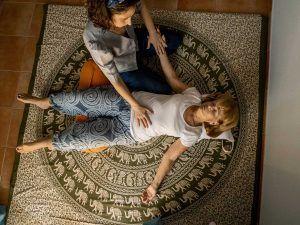
Shiatsu works on the meridians of Traditional Chinese Medicine through pressure of the fingers and hands. Applied to oneself, self-shiatsu on the hands is easy to learn and can be practiced at any time of day — before a class, after hours at the computer, or simply when you notice accumulated tension.
A basic sequence:
-
Palm pressure. Using your thumb, gently press the center of the palm and hold for a few seconds while breathing.
-
Stroke each finger. Hold the base of each finger and slide your thumb and index finger toward the tip, with a firm but comfortable pressure.
-
Rotation of the wrist. Hold the wrist with the opposite hand and draw slow circles, in both directions.
-
Opening the hand. Gently extend your fingers, one by one, noticing where resistance or stiffness appears.
Chronic hand strain is often an unconscious habit — it accumulates without us noticing, especially in those who work with their hands repetitively (writing, holding a steering wheel, a golf club, tools).
Self-shiatsu offers a direct way to bring that tension into consciousness and release it before it becomes permanent stiffness.
An Awake Hand Keeps an Awake Mind
Hand dexterity is not just a functional matter — it’s also an information pathway to the brain. When a hand loses mobility, whether due to sustained strain, injury, or simply disuse, the brain receives less sensory information from that area, and that loss of information tends to reinforce the stiffness pattern. It is a circle that feeds back: less movement, less information; less information, less movement.
Working the mobility of the hands — through mudras, self-shiatsu, or simply by moving the fingers attentively — interrupts that circle. It’s not about forcing or stretching aggressively, but about bringing awareness to an area that is often on autopilot. This awareness is, in itself, what allows the nervous system to reorganize the pattern and regain movement.
The Vitality of Hands Is the Vitality of Mind
There’s no need to book half an hour for this. Two or three minutes are enough: form a simple mudra while breathing, followed by a short self-shiatsu tour for each hand. The key is not in duration, but in the quality of care.
Agile hands are not just a sign of good joint mobility. They are a direct reflection of how the brain is: how much sensory information it receives, how much clarity it has, how much responsiveness it retains. When hands lose their vitality — they become stiff, clumsy, “deaf” to touch — it is not only the hand that ages or disconnects. It is a sign that the body-brain dialogue is fading at one of its richest points.
That’s why caring for hands with attention is not a cosmetic gesture or a whim of well-being. It is, literally, keeping alive one of the oldest and most uninterrupted conversations that the brain has with the world.
Comments, questions are very welcome.
María Uceda / Online & In person Classes
Referencies:
https://www.sciencedirect.com/science/article/pii/S0301051124002175